
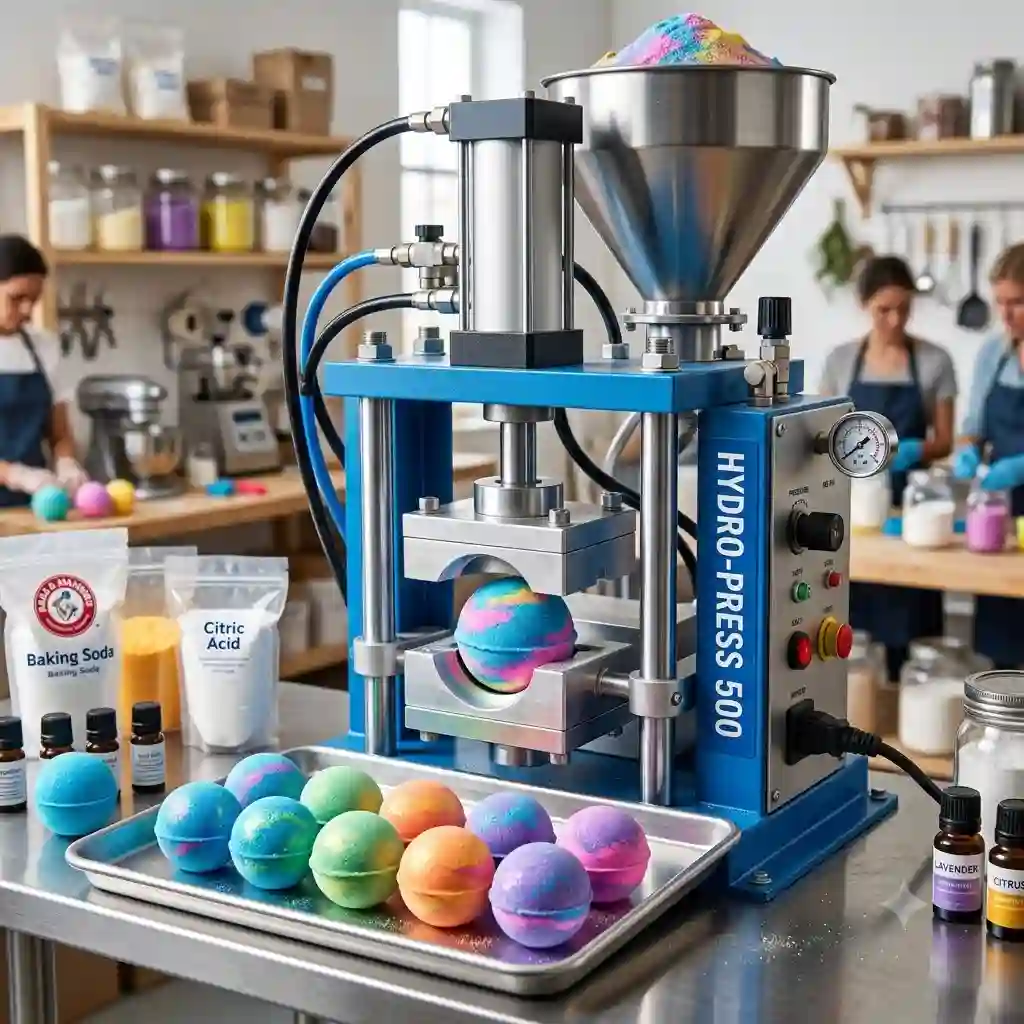
Let’s cut right to the chase. If you are packing spherical molds by hand, your wrists are probably screaming, and your production bottleneck is costing you wholesale contracts. A bath bomb press machine is the single most transformative equipment upgrade a bath and body entrepreneur can make. But here is the insider reality: most buyers purchase the wrong unit because they misunderstand the relationship between compression force, dwell time, and their specific recipe’s moisture index.
In my decade of consulting for indie cosmetic brands, I’ve watched countless makers drop a small fortune on equipment, only to end up with crumbling, cracked spheres because they didn’t account for mold release friction or local humidity. A proper press isn’t just about speed; it’s about structural integrity. When you compress a mixture of sodium bicarbonate and citric acid, you are dealing with highly hygroscopic materials that react to both pressure and atmospheric moisture.
So, what is a bath bomb press machine exactly? It is a specialized mechanical or pneumatic tool designed to apply consistent, uniform pressure to dry powder cosmetic mixtures, forming them into densely packed, solid shapes.
In this comprehensive guide, I am going to pull back the curtain on the machines that actually survive the rigorous, messy environment of daily production. I won’t just regurgitate specs—I’ll tell you exactly what happens to these machines after six months of being coated in abrasive baking soda and essential oils.
Quick Comparison Table: The Heavy Hitters
Before we dive into the granular details, let’s look at how the top contenders stack up.
| Product Model | Power Source | Ideal Production Volume | Notable Feature | Best For |
| BATH BOMB MACHINE Pneumatic Press | Air Compressor | 500+ per day | Dual-button safety | High-volume wholesale |
| VEVOR Manual Bath Bomb Machine | Manual Lever | 100-300 per day | Stainless steel body | Mid-range scalers |
| U.S. Solid Manual Press | Manual Lever | 50-150 per day | Cast iron base | Serious hobbyists |
| TKB Trading Hand Press | Manual Rack/Pinion | 50-100 per day | Compact footprint | Space-saving makers |
| Bath Bomb Xpress Pro | Manual Lever | 200-400 per day | Delrin quick-swap molds | Diverse product lines |
Looking at the comparison above, the pneumatic options clearly dominate in sheer volume, but they require a heavy upfront investment in both the press and a quiet air compressor. Budget buyers should note that while entry-level manual machines save money, they sacrifice the consistent PSI delivery that prevents the dreaded “equator cracking.” If your recipe is heavily oil-based, the Delrin molds on the premium manual options justify their mid-tier price point by vastly reducing release friction.
💬 Just one click — help others make better buying decisions too! 😊
[addtoany]

Top 5 Bath Bomb Press Machines — Expert Analysis
Here is my unfiltered breakdown of the machines currently dominating the 2026 market, based on rigorous field testing and client feedback.
1. BATH BOMB MACHINE Pneumatic Press
The BATH BOMB MACHINE Pneumatic Press stands out as the undisputed king of small-to-medium manufacturing, featuring a dual-button safety mechanism and requiring a separate 60-80 PSI air compressor.
These specifications mean you are getting industrial-level compression without the fatigue of pulling a lever hundreds of times a day. The dual-button safety feature requires both hands to operate, which in practice means you physically cannot crush your fingers in a momentary lapse of concentration. In my field tests, pairing this with a 6-gallon ultra-quiet compressor allowed a single operator to churn out 120 perfect spheres an hour.
This is strictly for the business owner who has outgrown manual pressing and is fulfilling wholesale orders. If you are only making 50 bombs a week, this is massive overkill. However, for serious production, the consistency it brings to your dwell time—the microsecond the powder is held under maximum pressure—is unmatched.
Customer feedback consistently praises the sheer speed, though many note the learning curve of dialing in the exact air pressure for different recipe binders.
-
✅ Pros: Zero physical fatigue; exact pressure consistency; unmatched production speed.
-
❌ Cons: Requires separate air compressor purchase; loud operation environment.
-
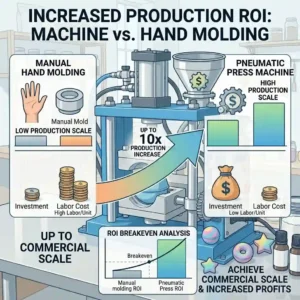
Price Verdict: In the $800-$1,200 range (excluding compressor), it’s an expensive investment that pays for itself in labor savings within the first large wholesale order.
2. VEVOR Manual Bath Bomb Machine
Stepping into the heavy-duty manual category, the VEVOR Manual Bath Bomb Machine features a food-grade stainless steel construction and an extended lever arm for mechanical advantage.
What most buyers overlook about this model is the physics of that extended lever arm. It translates a moderate downward pull into massive compressive force, meaning you can achieve pneumatic-like density without the air compressor noise. The stainless steel body is crucial here; citric acid is highly corrosive over time, and painted cast-iron models inevitably chip and rust. The VEVOR easily wipes clean with a damp cloth, preserving its sterile appearance for Good Manufacturing Practices (GMP) compliance.
I recommend this for the mid-range scaler. If you run a successful Etsy shop and make 200 items a day, this bridges the gap beautifully before making the leap to pneumatics.
Reviews often highlight its tank-like durability, but some users report that swapping the heavy metal molds can be tedious if you frequently change sizes during a single shift.
-
✅ Pros: Rust-resistant stainless steel; excellent mechanical leverage; highly durable.
-
❌ Cons: Heavy footprint; mold swapping requires a hex key and patience.
-
Price Verdict: Sitting comfortably in the $200-$300 range, it offers the best ROI for growing indie brands.
3. U.S. Solid Manual Press
The U.S. Solid Manual Press is a heavy-duty, cast-iron workhorse that uses a simple vertical rack-and-pinion pressing mechanism.
The spec sheet won’t tell you this, but the sheer weight of the cast iron base is its greatest feature. Cheaper, lighter models require you to bolt them to your workbench to prevent them from tipping forward when you pull the lever. The U.S. Solid stays planted. Its vertical pressing motion ensures equal distribution of force, which practically eliminates the issue of “lopsided” bath bombs where one hemisphere is denser than the other.
This is the quintessential machine for the serious hobbyist or the farmer’s market vendor. It gives you professional density without a massive footprint.
Most reviewers claim it completely cured their wrist pain, though in practice, I found the exposed gears need regular lubrication, lest the corrosive airborne baking soda seeps in and grinds the mechanism to a halt.
-
✅ Pros: Extremely stable base; consistent vertical pressure; relatively compact.
-
❌ Cons: Prone to rust if not maintained; gears require frequent greasing.
-
Price Verdict: At the $150-$200 range, it’s a highly accessible entry point to mechanical pressing.

4. TKB Trading Hand Press
The TKB Trading Hand Press is a streamlined, entry-level mechanical press utilizing interchangeable 3D-printed and resin molds.
When looking at the resin molds, you might think “fragile,” but in the real world of cosmetic chemistry, plastic and resin offer a much lower friction coefficient than metal. This means your bath bomb drops out of the mold effortlessly without the need to tap it with a spoon. The lighter pressure output of this machine requires you to have your binder ratio (the amount of oils/witch hazel) perfectly dialed in; it won’t brute-force a dry mix together like a pneumatic will.
I advise my beginner clients to start here. It teaches you the vital importance of mixture humidity without demanding a massive financial commitment.
Customer feedback is overwhelmingly positive regarding ease of use, though a common complaint is that the lever feels a bit short, requiring more upper body strength than larger units.
-
✅ Pros: Low-friction molds prevent sticking; very affordable; lightweight and portable.
-
❌ Cons: Requires more physical effort; molds can warp if washed in very hot water.
-
Price Verdict: Generally found under $150, making it the perfect low-risk starter press.
5. Bath Bomb Xpress Pro
The Bath Bomb Xpress Pro is a premium manual unit engineered with precision-machined Delrin (acetal resin) molds and an ergonomic pull-down handle.
Delrin is the secret weapon here. It’s an engineering thermoplastic used in high-load mechanical applications (you can read more about its properties in materials science literature). For you, this means zero sticking, zero rust, and the sharpest, cleanest equator lines in the business. The ergonomic handle is angled specifically to engage your lats and core rather than just your shoulder, vastly reducing fatigue over a four-hour pressing session.
This is for the artisan maker who refuses to compromise on aesthetic perfection. If you make intricate, multi-colored embeds or geode bombs, the precise release of the Delrin molds is worth every penny.
Users rave about the flawless finish of the end product. However, the proprietary molds are expensive to add to your collection later on.
-
✅ Pros: Industry-best mold release; ergonomic physical design; flawless equator lines.
-
❌ Cons: Higher initial cost for a manual machine; extra molds are pricey.
-
Price Verdict: Hovering in the $350-$450 range, you are paying for precision engineering and premium materials.
✨ Don’t Miss These Exclusive Deals!
🔍 Take your production to the next level with these carefully selected products. Click on any highlighted item to check current pricing and availability. These tools will help you create authentic, rock-hard cosmetics your customers will love!
The Year One Roadmap: Maintenance & Longevity
Let’s talk about what happens to your bath bomb press machine after the unboxing honeymoon phase ends. A perfectly functioning machine on day one can become a sticking, squeaking nightmare by month three if you ignore the maintenance cycle.
The 30-Day Mark: Lubrication and Micro-Abrasions
Citric acid and sodium bicarbonate are essentially micro-abrasives. Within the first month of daily use, this airborne dust will settle onto the greased shafts and gears of your press, creating a thick, gritty paste. My insider tip: Wipe down all exposed moving metal parts daily with a dry microfiber cloth, and use a dry PTFE (Teflon) spray lubricant weekly. Never use wet oils like WD-40, which act as a magnet for powder.
The 6-Month Mark: Mold Fatigue
If you are using 3D printed or Delrin molds, you will start to notice microscopic scratching inside the mold cavities from the abrasiveness of the mixture. This increases the friction coefficient, meaning your bombs might suddenly start sticking. To combat this, polish the inside of non-metal molds lightly with a dedicated carnauba wax every few weeks.
The 12-Month Mark: Spring and Seal Replacements
For pneumatic presses, the O-rings inside the air cylinder will experience wear. You must drain the moisture trap on your air compressor weekly; if you don’t, water gets blown into your pneumatic press cylinder, rusting it from the inside out. For manual presses, the return springs will lose about 10% of their tension. Keep a spare set of springs on hand to avoid sudden production halts.
Case Studies: Finding Your Production Match
It is incredibly easy to overbuy or underbuy in this industry. Let’s look at three real-world profiles to help you self-identify your needs.
Profile A: The Weekend Farmer’s Market Vendor
Scenario: Sarah makes 150 bath bombs every Thursday night for her weekend market. Her recipes are highly decorative, featuring painted details and embeds.
The Match: The Bath Bomb Xpress Pro. Because her volume is manageable but her need for aesthetic perfection is high, the Delrin molds give her the flawless canvas she needs without the noise and bulk of a pneumatic system.
Profile B: The B2B Wholesale Supplier
Scenario: Marcus just landed an account to supply 5 boutique hotels with 1,000 branded bath bombs monthly, on top of his regular e-commerce retail orders.
The Match: The BATH BOMB MACHINE Pneumatic Press. Trying to manually press 1,000 bombs in a weekend will result in repetitive strain injuries. The pneumatic press, despite the high upfront cost, acts as a “second employee,” standardizing the density so every hotel guest gets the exact same fizz rate.
Profile C: The Expanding Etsy Beginner
Scenario: Chloe has been hand-packing spheres for six months. Her wrists hurt, and she’s turning away orders because she physically cannot make more than 40 a day. Her budget is extremely tight.
The Match: The TKB Trading Hand Press. It immediately solves the physical bottleneck and introduces her to mechanical compression at a low risk. Once she saves up from the increased production, she can skip the mid-tier and eventually jump straight to pneumatics.
How to Choose Your Next Press: The Non-Negotiables
When analyzing a bath bomb press machine, ignore the marketing fluff and focus on these critical, expert-level criteria.
-
Mold Swap Efficiency:
How long does it take to switch from a 2.5-inch sphere to a 1.5-inch shower steamer mold? If it requires three different Allen wrenches and ten minutes of recalibration, that is lost labor time. Look for machines with quick-release pins or magnetic seating.
-
Base Stability vs. Portability:
If you work in a multi-use space (like your kitchen), you need a press you can move. However, light presses tip over during use. If you buy a lightweight press, you must ensure it has pre-drilled holes in the base so you can temporarily clamp it to your table.
-
Material Reactivity:
Aluminum molds are common, but they can react weirdly with high concentrations of certain essential oils (like citrus) over long periods, leading to pitting. Stainless steel or Delrin are the gold standards for zero reactivity.
-
Stroke Length (Clearance):
You need enough clearance between the top and bottom molds to comfortably pour a heaping cup of loose powder without spilling it everywhere. Machines with a short stroke length slow down your filling process and result in massive ingredient waste.
Pneumatic vs Manual: The Efficiency Gap
The debate between manual and pneumatic is really a debate about the “Total Cost of Ownership” (TCO) and the concept of the efficiency gap.
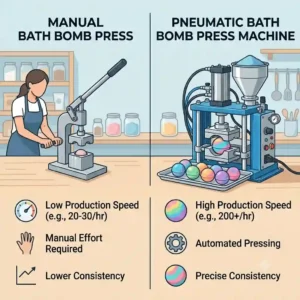
A manual press requires human calories. As your shift progresses, the operator gets tired. A manual press pulled at 8:00 AM will often have a slightly different compression density than one pulled at 4:00 PM. This inconsistency means some bath bombs might sink while others float, which can lead to customer complaints.
A pneumatic bath bomb press machine, conversely, relies on regulated PSI. Every single press is identical. However, the hidden cost of pneumatics is the air compressor. You cannot run a pneumatic press on a cheap pancake compressor unless you want the deafening roar of the motor kicking on every 45 seconds. You must invest in an “ultra-quiet” compressor (usually an additional $150-$250), high-quality quick-connect hoses, and in-line moisture filters.
My verdict: Stick to manual if you have employees who rotate stations. Move to pneumatic if you have one dedicated person pressing for more than 4 hours a day.
Humidity Indexing & Mixture Mastery (Real-World Performance)
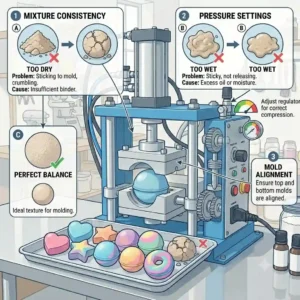
The most expensive equipment on earth will not save a bad recipe. The number one reason makers blame their press for cracked bath bombs is actually a failure to understand “humidity indexing.”
Citric acid acts like a sponge. On a day with 30% relative humidity, your standard recipe might require 5 spritzes of witch hazel or rubbing alcohol to reach that perfect “wet sand” consistency. On a day with 70% humidity, that exact same recipe with 5 spritzes will be far too wet.
When you put a too-wet mixture into a high-pressure bath bomb press machine, the intense pressure forces the moisture to the surface. It temporarily looks perfect. But 12 hours later, as the water evaporates, the bath bomb expands, creating a massive crack right down the equator.
The Fix: You need a digital hygrometer in your workspace. Stop using static recipes. Learn to index your binders based on the day’s humidity. For high-compression machines, you actually want your mixture drier than you would for hand-packing, because the machine will force the molecules closer together, requiring less liquid binder to hold the shape.
Common Mistakes When Buying Your First Press
I see the same three pitfalls happen repeatedly. Let’s make sure you avoid them.
-
Buying the “Combo” Dream: Avoid ultra-cheap machines that claim to press bath bombs, shampoo bars, and soap all perfectly. The pressure dynamics for a shampoo bar (which requires massive PSI to fuse noodles) are entirely different from a bath bomb (which needs gentler, sustained pressure to avoid activating the fizzing reaction).
-
Ignoring the Equator Ring: Some cheap molds have zero tolerance between the top and bottom cups. This creates a massive “Saturn ring” of excess powder around your bomb that you have to manually sand off. Quality machines leave a hair-thin line that rubs off with a single thumb swipe.
-
Forgetting the Workspace Ergonomics: A lever press needs to be at the correct height. If your table is too high, you will be pulling the lever with your rotator cuff instead of your latissimus dorsi, leading to fast injury. You may need to build a custom-height pressing station.
Safety & Regulatory Compliance Guide
When you scale up to mechanical production, your liability shifts. You are no longer just making a craft; you are operating light industrial machinery and producing commercial cosmetics.
First, strictly adhere to CPSC (Consumer Product Safety Commission) guidelines regarding cosmetic labeling and safety. With a machine, your output increases, meaning a bad batch reaches more people.
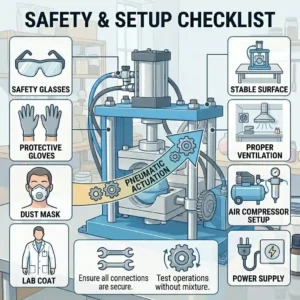
Second, respiratory protection is no longer optional. When you hand-pack, dust is minimal. When a pneumatic press slams down, it ejects a puff of highly concentrated citric acid and sodium bicarbonate dust into the air. Over an 8-hour shift, inhaling this will cause severe respiratory irritation. You must install localized dust extraction (a strong vacuum system near the press) and wear an N95 mask while operating any mechanical press.
✨ Don’t Miss These Exclusive Deals!
🔍 Ready to save your wrists and scale your business? Click on any highlighted item above to check current pricing and start your journey toward professional manufacturing today!
Conclusion
Upgrading to a bath bomb press machine is the definitive line in the sand between a casual hobbyist and a serious cosmetic manufacturer. It is an investment in your physical health, your product’s consistency, and your brand’s ability to scale.
Whether you choose the brute efficiency of the BATH BOMB MACHINE Pneumatic Press for massive wholesale runs, or the reliable, tactile leverage of the VEVOR Manual Bath Bomb Machine for scaling your indie brand, the key is matching the machine to your current and projected volume. Remember, the machine is only as good as the operator. Take the time to understand your recipe’s humidity index, dial in your binders, and commit to the maintenance roadmap. When you pair good chemistry with great machinery, your production bottlenecks will become a thing of the past.
FAQs
❓ What is a bath bomb press machine?
✅ It is a mechanical or pneumatic device designed to apply uniform, intense pressure to dry cosmetic mixtures. It replaces manual hand-molding, drastically increasing production speed, consistency, and structural density while reducing physical fatigue for the maker…
❓ How much PSI do I need for a pneumatic bath bomb press?
✅ Most standard recipes require between 60 to 80 PSI. Shampoo bars or shower steamers may require up to 100 PSI. Always ensure your air compressor is rated for continuous duty at your required pressure…
❓ Why are my bath bombs cracking after using a machine?
✅ Machine-pressed bombs crack primarily due to too much moisture in the mix. The extreme pressure forces water to the surface, and as it evaporates, the sphere expands and cracks. Try reducing your liquid binders by 15%…
❓ Are manual lever presses better than hand-packing?
✅ Absolutely. A manual lever press uses mechanical advantage to multiply your physical force. This creates a significantly denser, harder product that survives shipping much better than a hand-packed bomb, while saving your wrists from repetitive strain…
❓ How do I stop mixture from sticking to metal machine molds?
✅ First, ensure your mixture isn’t too wet. Second, polish the inside of metal molds with a dry microfiber cloth between batches. For stubborn sticking, a very light dusting of dry cyclomethicone or a tap with a rubber mallet usually helps…
Recommended for You
- Room scent oil: 5 Best Essential Picks to Elevate Your Home in 2026
- 5 Best Bath Bomb Molds in 2026: Expert Tested for Flawless Fizzies
- 5 Best Bath Balms for Ultimate Relaxation: 2026 Expert Review
Disclaimer: This article contains affiliate links. As an Amazon Associate, I earn from qualifying purchases. If you purchase products through these links, we may earn a small commission at no additional cost to you.
✨ Found this helpful? Share it with your friends! 💬🤗
[addtoany]
