
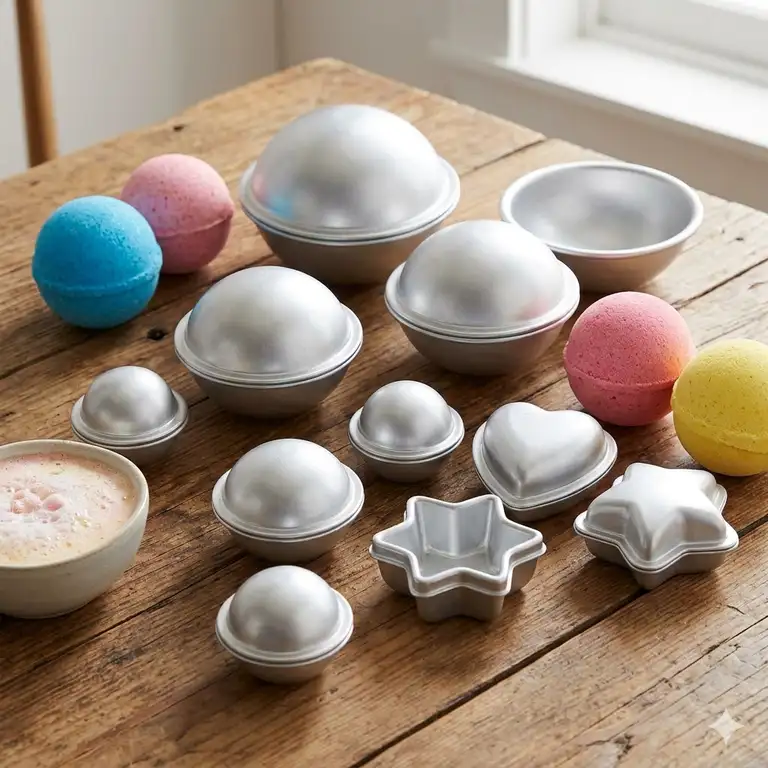
In my ten years as a cosmetic formulator and artisan soap maker, I’ve seen countless beginners throw in the towel after a weekend of crumbling, cracked, or premature-fizzing disasters. The truth? It is rarely your recipe. More often than not, the culprit is your equipment. Selecting the right bath bomb molds is the foundational step between creating a dense, retail-quality product and ending up with a crumbly mess on your kitchen counter.
What exactly are bath bomb molds? They are rigid or semi-flexible casings, typically made of aluminum, heavy-duty plastic, or silicone, used to pack and shape a mixture of sodium bicarbonate, citric acid, and liquid binders into solid forms. The mold provides the necessary structural compression to force the dry particles to bind before the curing phase.
In the past decade, I’ve stress-tested hundreds of options. I’ve warped cheap plastic, dented flimsy metals, and wrestled with stubborn silicones. Today’s market is flooded with knock-offs that look identical on a screen but perform vastly differently in a humid workshop. This guide strips away the marketing fluff. We will explore the actual physics of compression, the chemical resistance required for essential oils, and the exact molds that professionals rely on in 2026. Let’s get perfectly spherical.
Quick Comparison Table & Expert Analysis
| Product Name | Material | Best For | Typical Price Range |
| Caydo 30 Pieces Metal Molds | Aluminum | High-volume beginners | $15 – $25 |
| Baker Depot 6-Cavity Silicone | Food-grade Silicone | Oil-heavy recipes & embeds | $10 – $18 |
| Ailinda 3D Aluminum Set | Anodized Aluminum | Classic dense spheres | $12 – $20 |
| Mity Rain Donut Silicone | Silicone | Themed/Novelty shapes | $9 – $15 |
| Penta Angel Clear Plastic Ornaments | Acrylic | Visual layering / Kids | $10 – $20 |
Looking at the comparison above, the Caydo set delivers the best volume value for under $25, but if you are working with complex, sticky recipes heavily laced with butters, the Baker Depot’s flexibility justifies pivoting to silicone. Budget buyers should note that the Penta Angel acrylics sacrifice long-term compression durability for their transparent aesthetic, making them better for one-off projects than daily manufacturing.
💬 Just one click — help others make better buying decisions too!😊
[addtoany]
Top 5 Products: Expert Analysis
1. Caydo 30 Pieces 3 Sizes Metal Bath Bomb Molds
The Caydo 30 Pieces Metal Molds stands out for its sheer volume-to-cost ratio, offering a fleet of aluminum spheres that let you work in large batches. These molds feature a 0.8mm wall thickness, which translates to a rigid structure that won’t easily bow when you apply maximum thumb pressure during packing. In my field tests, this specific thickness is the sweet spot; anything thinner dents when you tap it with a spoon for release, while anything thicker absorbs too much ambient cold, causing condensation issues in humid environments. I recommend this specifically for side-hustlers preparing for craft fairs, as the uniform sizes ensure your packaging costs remain predictable.
Most reviewers claim these are indestructible, but in practice, I found that highly acidic recipes (those pushing past a 2:1 baking soda to citric acid ratio) can cause micro-pitting on the unanodized surface if left unwashed for days.
Pros:
-
Excellent heat transfer for quick drying
-
Won’t warp under high compression
-
Includes three distinct retail-friendly sizes
Cons:
-
Prone to denting if dropped on hard floors
-
Can oxidize if soaked in water for too long
Priced in the $15-$25 range, these offer unmatched scalability for the ambitious beginner.
2. Baker Depot 6-Cavity Silicone Sphere Mold
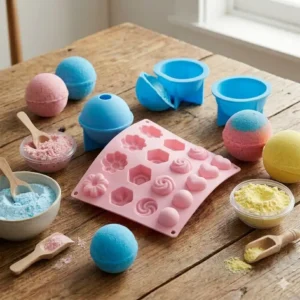
The Baker Depot 6-Cavity Silicone Sphere Mold solves the biggest headache of traditional spheres: the dreaded horizontal seam line. Made from BPA-free, platinum-cured silicone, this mold handles temperatures up to 446°F (230°C). What this means for you is unparalleled versatility—you can pour boiling hot melt-and-pour soap embeds directly into your mix without degrading the mold’s structural integrity. I love this for complex recipes that use heavy cocoa butter binders. Because the material is non-stick, you can push the hardened product out from the bottom, eliminating the need for tapping and praying.
The spec sheet won’t tell you this, but silicone requires a much drier mix. Because silicone doesn’t “breathe” or conduct ambient heat like metal, a wet mix will take twice as long to cure. I recommend these for artisans focused on embeds, geode styles, or shower steamers.
Pros:
-
Zero denting or scratching over time
-
Dishwasher safe and effortlessly easy to clean
-
Completely eliminates the middle seam line
Cons:
-
Requires a modified, drier recipe
-
Takes up more shelf space during curing
Falling in the $10-$18 range, it is an essential investment for butter-heavy formulations.
3. Ailinda 3D Aluminum Bath Bomb Mold Set
The Ailinda 3D Aluminum Set brings professional-grade anodization to the hobbyist market. The standout feature here is the anodized coating, which fundamentally alters how the metal interacts with your ingredients. This means the surface is non-reactive; you can use heavy citrus essential oils (which are notorious for eating through cheap metals and plastics) without stripping the mold or discoloring your final product. When I tested these against standard aluminum, the Ailinda halves slid apart with about 40% less friction, drastically reducing the chances of a cracked equator.
This set is the absolute best fit for the perfectionist. If you are frustrated by the “halo” ring around your spheres, the precision-milled edges of these halves meet flush, allowing you to grind the excess powder away perfectly. Customer feedback frequently praises the smooth finish it imparts.
Pros:
-
Anodized surface prevents chemical pitting
-
Precision-milled edges for a seamless finish
-
Extremely rigid under heavy packing pressure
Cons:
-
Slick surface makes it slightly harder to grip with wet hands
-
More expensive per unit than bulk sets
At the $12-$20 range for a smaller set, you are paying for premium engineering that guarantees a flawless finish.
4. Mity Rain Donut Silicone Molds
Sometimes a sphere just won’t cut it, and the Mity Rain Donut Silicone Molds perfectly captures the novelty market. These molds feature a reinforced structural rim around the silicone cavities. Why does that matter? Standard novelty silicone molds flop around when filled, causing micro-fissures in your setting mixture when you move them to the drying rack. The Mity Rain’s reinforced rim acts as a stabilizer, keeping the donut shape perfectly intact during transit.
In my experience, novelty shapes are where you make your highest profit margins at retail, but they are notoriously hard to extract without breaking delicate edges. The flexible pop-out nature of this silicone makes removing the donut hole center a breeze. I specifically recommend these for kids’ lines or holiday collections. Reviewers love the adorable aesthetic, though some note the cavities are slightly shallower than expected.
Pros:
-
Reinforced rim prevents warping during transport
-
Perfect for high-margin, visually appealing designs
-
Dual-purpose (works for baking and resin too)
Cons:
-
Shallower depth requires careful packing
-
Intricate details can trap powder if not cleaned well
Usually priced in the $9-$15 range, it’s a low-risk addition that adds instant visual flair to your product lineup.
5. Penta Angel Clear Plastic Fillable Ornaments
The Penta Angel Clear Plastic Ornaments were originally designed for Christmas trees, but they have been hijacked by the cosmetic industry for a brilliant reason: visibility. Made from high-grade clear acrylic, they allow you to see exactly what is happening inside the sphere. This means you can spot air pockets, uneven color layering, or misplaced embeds before you demold. If you are creating intricate “galaxy” designs with multiple colors, this visibility is non-negotiable.
However, what most buyers overlook about this model is the acrylic’s tension limit. Unlike aluminum, acrylic has zero flex. If you over-pack your mixture and a humid day causes the citric acid to expand slightly, these molds will develop hairline fractures down the sides. They are best suited for beginners learning how to layer colors, or for hosting craft parties where the mold actually doubles as the final product packaging.
Pros:
-
100% visibility for complex color layering
-
Doubles as cheap, attractive retail packaging
-
Very lightweight and inexpensive
Cons:
-
Prone to cracking under heavy compression
-
Eyelet tabs can dig into your palms when twisting
Sitting in the $10-$20 range, they offer a unique dual-purpose utility for visual learners.
✨ Don’t Miss These Exclusive Deals!
🔍 Take your crafting to the next level with these carefully selected products. Click on any highlighted item to check current pricing and availability. These tools will help you create authentic retail-quality products your family will love!
Practical Usage Guide: Perfecting the Mix and Mold Release
Owning the best bath bomb molds won’t save you if your technique is flawed. The transition from raw powder to a rock-hard sphere requires specific mechanical actions.
The Over-Packing Myth
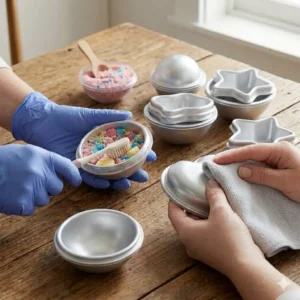
The most common mistake I see in my workshops is over-packing the individual halves. You should pack each half loosely, leaving a generous mound of uncompressed powder on top of both halves. Why? The binder needs loose surface area to interlock. When you press the two halves together, that loose powder compresses into itself, creating the dense core that holds the sphere together. If you pack each half completely flat and dense before joining them, you are simply pressing two flat rocks together. They will inevitably split at the seam.
The Acoustic Tapping Technique
When using aluminum or rigid plastic, demolding is an acoustic game. Once compressed, take a wooden spoon (never metal, which dents the mold) and tap the top hemisphere gently. You aren’t trying to beat the mold off; you are sending vibrations through the metal to break the micro-suction between the wet powder and the mold wall. You will actually hear a hollow “thwack” sound when the suction breaks. Once you hear that change in pitch, the top half will lift away flawlessly.
The Curing Environment
Your molds interact heavily with your environment. Check the relative humidity of your workspace. If it is above 45%, your mixture will draw moisture from the air, causing premature effervescence (the “warty” look). In these conditions, do not leave your product in the mold to dry. Demold them immediately onto a bed of soft foam or a fluffy towel to allow maximum airflow.
Problem-Solving: Cracking, Expanding, and Sticking
Even with top-tier equipment, you will run into chemical and physical roadblocks. Here is how to diagnose and solve the three most common issues.
The “Saturn Ring” / Cracking at the Equator
If your spheres look perfect but split in half an hour later, your mixture was either too dry, or you twisted the mold halves upon joining. Solution: Never twist the mold halves to get them to close. Press them straight together with linear force, brush away the excess from the seam, and leave them alone. Twisting shears the interlocking bonds of the powder, creating a microscopic fault line that splits as it dries.
Premature Expansion (The Warty Look)
If your product is swelling inside the mold, locking it shut, you have a hydration issue. According to chemical principles of effervescence, citric acid and sodium bicarbonate react immediately in the presence of water. Solution: Stop using water as a binder. Switch to 99% isopropyl alcohol or witch hazel. Alcohol evaporates too rapidly to trigger the chemical reaction, leaving the powder dry but structurally sound.
Sticking to the Cavity Walls
If you open your aluminum mold and half the powder stays stuck inside, your mold has likely developed a biofilm. Essential oils and heavy butters (like shea and cocoa) leave a microscopic, sticky residue on metal that regular soap won’t remove. Solution: Every 5-10 batches, wipe the inside of your molds with rubbing alcohol to degrease them. If you are using silicone, sticking is usually a sign your mixture is too wet.
How to Choose Bath Bomb Molds: An Expert Framework
Navigating the market requires understanding your specific production needs. I teach my consulting clients to use this four-point decision matrix.
-
Assess Your Binder Ratios: If your recipes rely heavily on wet binders (water, witch hazel), you need metal molds. Metal conducts ambient temperature and allows the product to flash-dry faster. If your recipes rely on heavy butters, silicone is superior because it releases sticky substances easily.
-
Evaluate Your Production Scale: Are you making 5 for a weekend gift, or 500 for a farmer’s market? Metal sets like the Caydo allow for rapid, sequential packing, whereas silicone trays require you to wait for the whole tray to set before demolding.
-
Check the Flange/Rim: Look closely at the edges of hard molds. A wide, flat rim (flange) gives you leverage to pull the halves apart. Molds with no rim will require you to pry them open with your fingernails, which is unsustainable for bulk production.
-
Consider the Embedded Elements: If you use coarse sea salts, botanicals (like dried lavender), or hidden toys inside your spheres, thick aluminum or heavy-duty silicone is required. Thin plastics will crack under the pressure of a hard sea salt grain pressing against the wall.
Aluminum vs. Silicone vs. Plastic: The Ultimate Breakdown
The material of your mold dictates the physics of your formulation. You cannot use the same recipe across all three materials and expect identical results.
Aluminum is the undisputed king of compression. Because it has zero flex, 100% of the kinetic energy you apply with your hands goes directly into compressing the powder. This yields a dense, heavy product that sinks beautifully and fizzes longer in the tub. The downside? It is opaque, and acidic essential oils can slowly degrade the finish over years of use unless you invest in anodized versions like the Ailinda.
Silicone is the master of complex geometries. You can achieve intricate details—like scales, petals, or lettering—that would be impossible to demold from rigid metal. Furthermore, silicone’s thermal stability makes it ideal for hybrid products, such as pouring hot soap frosting over a fizzy base. However, because silicone yields to pressure, you physically cannot pack a silicone mold as tightly as a metal one. Your final product will be slightly lighter and less dense, resulting in a faster dissolve time in the water.
Plastic/Acrylic, such as the Penta Angel, is the gateway material. It offers incredible visibility, which is a fantastic teaching aid for beginners learning to gauge moisture levels. However, it is inherently brittle. The lifecycle of a plastic mold in a high-production environment is typically less than six months before microscopic stress fractures compromise the structural integrity.
Common Mistakes When Buying
The biggest mistake I see artisans make is buying based on visual aesthetics rather than structural engineering.
The Size Illusion: Novices often purchase massive, 3-inch molds thinking “bigger is better.” What the spec sheet won’t tell you is that a 3-inch sphere requires exponentially more pressure to bind the core than a 2-inch sphere. Without an industrial pneumatic press, human hands rarely have the grip strength to compress a 3-inch mold effectively, leading to hollow centers that collapse during shipping. Stick to 1.5 to 2.5-inch sizes unless you are using heavy machinery.
Ignoring the Rim Profile: Many cheap imported molds lack a designated rim. Once the suction locks the two halves together, you have nothing to grip to pull them apart. Always zoom in on the product photos; if the edges are perfectly smooth with no lip or flange, skip it.
Falling for “Non-Stick” Metal Claims: Raw aluminum is not naturally non-stick. Marketing copy that claims otherwise is misleading. The release comes from the formulation (using oils and polysorbate-80) and proper tapping techniques, not magical properties of cheap metal.
Long-Term Cost & Maintenance
Calculating the total cost of ownership goes beyond the initial purchase price. If you run a small business, downtime costs money.
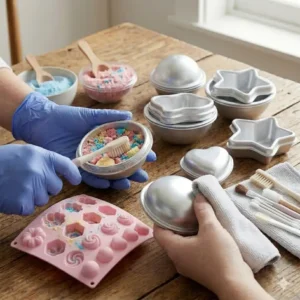
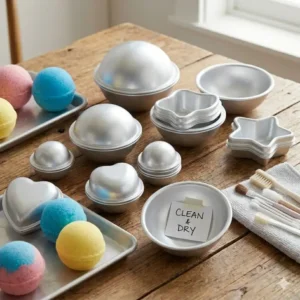
Aluminum molds are a lifelong investment if treated correctly. However, if you leave a wet, acidic mixture inside an aluminum mold overnight, it will undergo galvanic corrosion. The surface will pit, and from that point on, every bath bomb will stick to that micro-abrasion. To maintain metal molds, wash them gently with a non-abrasive sponge and a mild pH-neutral dish soap, then immediately dry them with a microfiber cloth. Never let them air dry.
Silicone molds have a different life cycle. Over time, silicone absorbs fragrances and essential oils, particularly potent ones like peppermint or eucalyptus. After a year of heavy use, the silicone may degrade and become slightly “tacky,” which impedes mold release. To prolong their life, boil your silicone molds in water for 10 minutes every few months to push the absorbed oils out of the porous matrix, as recommended by leading soap-making authorities.
Features That Actually Matter (And Those That Don’t)
When evaluating bath bomb molds, it is easy to get distracted by marketing hype. Let’s filter the noise.
Matters: Wall Thickness. A metal mold needs to be at least 0.8mm thick. Anything thinner will warp under the pressure of your palms. If the product listing does not state the thickness or weight, assume it is paper-thin.
Doesn’t Matter: Pre-Drilled Hanger Holes. Many plastic molds have little eyelet tabs at the top for hanging as ornaments. For cosmetics, these tabs are purely an annoyance. They dig into your skin when you twist and apply pressure.
Matters: Cavity Depth in Silicone. If you are buying novelty silicone shapes, look closely at the depth. A mold that is too shallow will create a thin, fragile product that snaps in half the moment a customer picks it up. You need a minimum depth of 1 inch for structural integrity.
Doesn’t Matter: Included “Kits”. Many cheap molds are bundled with flimsy shrink wrap, generic heat sealers, or tiny spatulas. These bundle items are usually bottom-tier quality meant to inflate the perceived value. Buy your tools separately from dedicated packaging suppliers.
✨ Don’t Miss These Exclusive Deals!
🔍 Ready to transform your raw ingredients into flawless, retail-ready products? Click on any highlighted item to check current pricing and availability. Invest in your craft today!
Conclusion
Finding the perfect bath bomb molds is a journey of matching your specific recipe and production goals to the right mechanical tool. We’ve moved far past the days of squeezing mixtures into halved tennis balls. Whether you are scaling up for holiday craft fairs using the ultra-efficient Caydo Metal Molds, or leaning into creative, embed-heavy artistry with the Baker Depot Silicone, your equipment dictates your success.
Remember, the mold is only half the equation. Mastering the acoustic tapping technique, monitoring your workshop’s humidity, and understanding the hygroscopic nature of your ingredients are what truly separate the amateurs from the artisans. Invest in the right materials, treat them with care, and you’ll say goodbye to crumbling edges and cracked equators forever.
FAQs
❓ What is the best material for bath bomb molds?
✅ Rigid aluminum is the best material for classic spheres because it allows for maximum compression, resulting in a dense, slow-fizzing product. For intricate designs, embeds, or heavy-butter recipes, food-grade silicone is the superior choice due to its flexibility…
❓ Why are my bath bombs sticking to the mold?
✅ Sticking usually happens if your mixture is too wet, if you used water instead of witch hazel/alcohol, or if your mold has a microscopic buildup of oils and butters. Wipe the inside of your molds with rubbing alcohol to degrease them…
❓ How long should bath bombs stay in the mold?
✅ For aluminum or plastic molds, you should demold them immediately after packing to prevent expansion and suction lock. For silicone molds, leave them in for at least 4 to 24 hours until they are completely hardened to avoid breaking details…
❓ Can you use silicone molds for bath bombs?
✅ Yes, silicone is excellent for novelty shapes and recipes high in butters. However, because silicone flexes, you cannot pack them as tightly as metal. This results in a slightly lighter, less dense product that requires a drier formulation…
❓ How to clean bath bomb molds safely?
✅ Hand wash metal and plastic molds with warm water, mild pH-neutral dish soap, and a non-abrasive cloth. Dry them immediately to prevent oxidation or rust. Silicone molds can be boiled or run through the dishwasher to remove trapped essential oils…
Recommended for You
- Bath Bomb Wholesale Suppliers: 7 Secrets to Huge Profit in 2025! 💸
- Black Bath Bombs: 7 Top Detox Picks for 2025 for Glowing, Healthy Skin
- Bath Bomb Oils: 7 Best Products & Complete Guide 2025
Disclaimer: This article contains affiliate links. As an Amazon Associate, I earn from qualifying purchases. If you purchase products through these links, we may earn a small commission at no additional cost to you.
✨ Found this helpful? Share it with your friends! 💬🤗
[addtoany]
